LMT Demonstrates Satellite Communication Solution for Network Resilience During Storms and Power Outages
To strengthen the resilience of the mobile communication network in emergency situations, “Latvijas Mobilais Telefons” (LMT) will demonstrate the integration of satellite technology into the mobile network today in Meņģele, Ogres region. The solution will allow residents and businesses to communicate even if traditional mobile communications are unavailable due to severe storms or prolonged power disruptions.
The demonstration site was not chosen randomly — the Ogres region is an area that was severely affected by a storm this year, posing challenges to communication infrastructure as well. During the event, it will be shown in real conditions how satellite internet can serve as a backup channel for voice calls at the Meņģele parish administration.
As explained by LMT Group's Technical Director Aigars Benders in a conversation with “Skonto Media Group,” although the mobile network will remain the main mode of communication, satellite technologies will increasingly join it in the future.
“In emergency situations, when storms or power outages — which are also consequences of storms, due to line damages — can affect the operation of the mobile network in the long term. In the short term, of course, our network will operate on batteries, but if it is a long-term interruption, well, several days, as it has been in the storm until now, it has, of course, also caused communication problems. Yes, the main benefit is greater security and communication availability. For people, it also means greater opportunities to communicate even in situations where traditional communications are disrupted, and for businesses — greater operational continuity,” explains LMT Group's Technical Director in an interview with SMG.
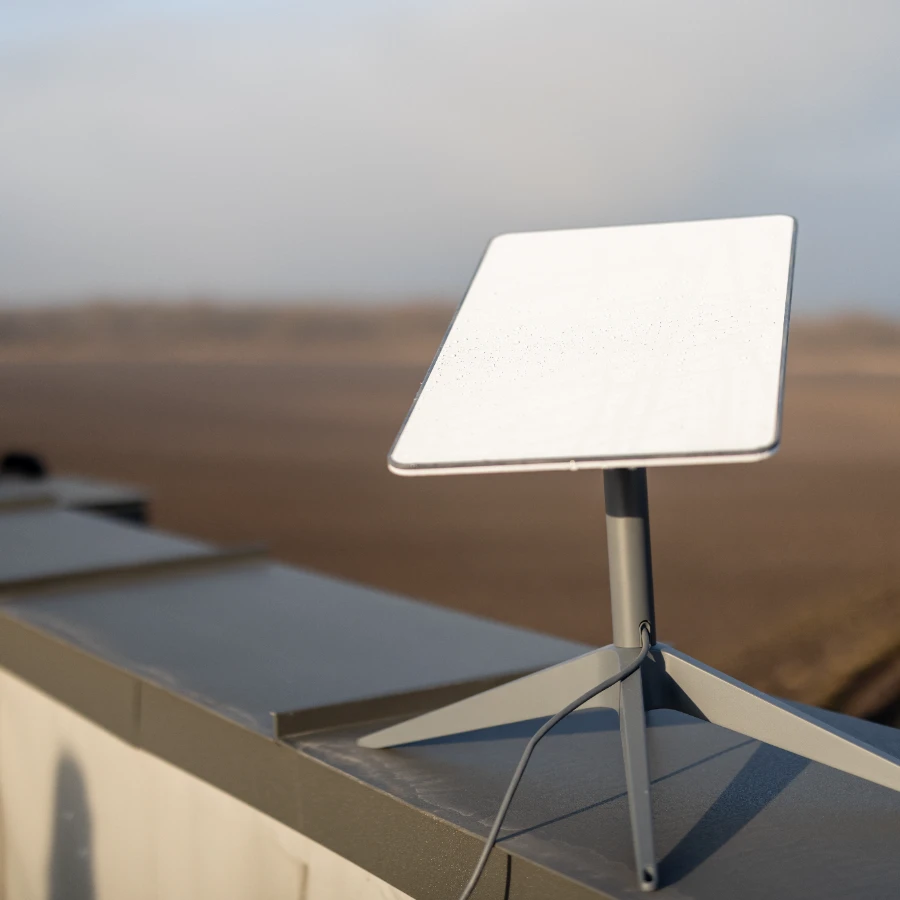
In the demonstrations, an emergency situation will be modeled by turning on airplane mode on phones to simulate the loss of mobile network coverage. At such a moment, the smartphone will automatically connect to the local home Wi-Fi network, which in turn will be connected to a satellite antenna. Using Voice over Wi-Fi technology, the user will be able to make regular voice calls via satellite.
Currently, LMT is testing the solution in collaboration with the global satellite operator Starlink, as it currently has the widest coverage in the region. As A. Benders points out, in practice, this means supplementing the existing home router with a satellite antenna. If the mobile network base station batteries run out due to a prolonged power outage and the signal disappears, the router automatically switches to a satellite connection.
LMT is also testing another technological direction in parallel — a direct connection between a regular mobile phone and a satellite without any intermediary devices or additional antennas. However, as the LMT Technical Director admits, this technology is still in the early stages of development and testing in Europe, and it will take time to achieve full coverage throughout Latvia.
After the demonstrations, LMT will evaluate customer interest and the costs of the solution to decide on its introduction into the commercial offering.