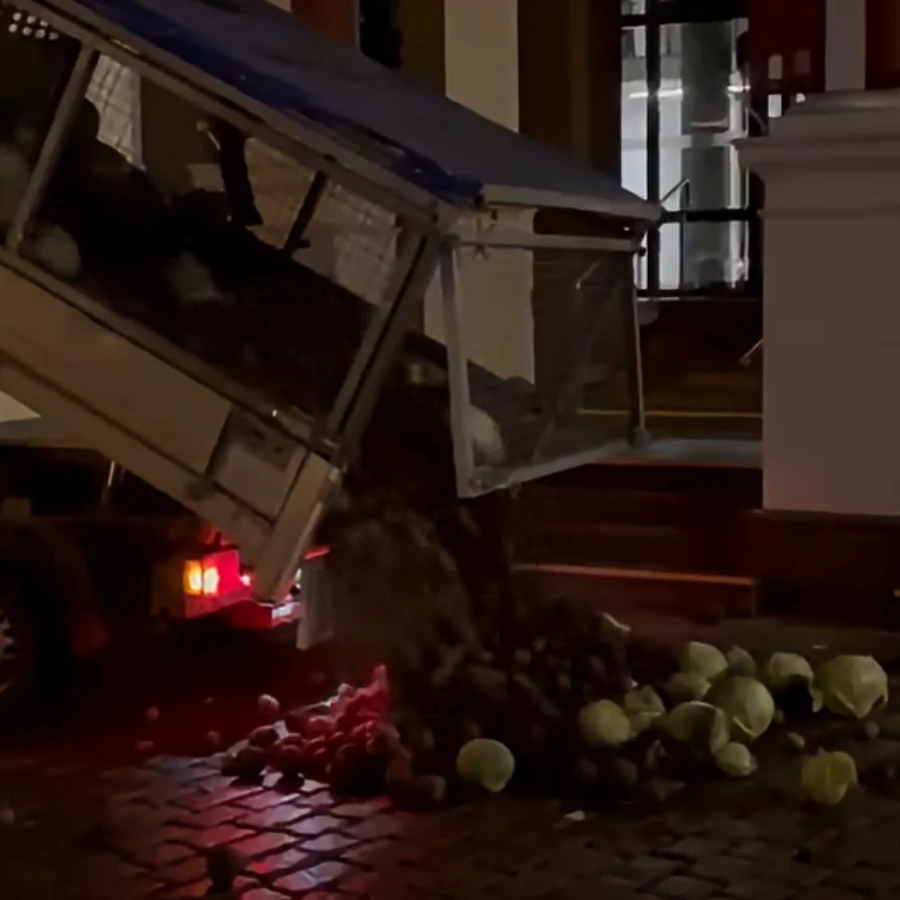
Farmers Protest Against Municipality's Catering Procurements by Dumping Vegetables at Riga City Council
Farmers today dumped several tons of vegetables grown in Latvia at the Riga City Council, protesting against the municipality's food and educational institution catering procurements, the association "Farmers' Parliament" informed the LETA agency.
The board member of the association, Mārtiņš Trons, notes that November is a month of patriotism, unity, and gratitude, and with this action, farmers want to remind the deputies of the Riga City Council that true patriotism must be demonstrated through real actions. Although politicians publicly declare that efforts should be made to ensure that children eat more local food and that Latvian farmers and producers are supported, there are growing concerns that in the near future, products grown in neighboring and third countries could take an even greater place in school and kindergarten catering.
Meanwhile, the "Farmers' Parliament" mentions that this year the Riga municipality announced a catering service procurement worth 26.8 million euros for 27 educational institutions. The procurement regulations stipulate that the delivery distance for certain products can reach 300 kilometers from the Riga border. This radius covers vast territories of neighboring countries where the possibilities of Latvian supervisory authorities to verify the true origin, quality, and compliance of products are limited. The Riga City Council has not responded to the association's repeated calls to stop the procurement, so the association decided to draw public attention to the municipality's procurements in this way. Moreover, this procurement will be followed by a procurement for catering in 101 educational institutions.
"The Riga City Council has done a 'bear's service' to Latvian farmers in the field of food procurement. On one hand, support for local producers and quality food for children is promised, but on the other hand, the procurement system does not ensure that what Latvian farmers grow actually reaches school canteens. A 300-kilometer distance from the Riga border means that preschool and school children's plates can contain food grown and produced in both neighboring and third countries," says Trons.
He also notes that it is sad to realize this, knowing that at the same time, neighboring countries have "locked the doors with ten locks" for Latvian farmers in their catering procurements, thus supporting their own.
Trons emphasizes that Riga should set an example for the entire country by providing Latvian farmers with real opportunities to participate in school catering supplies.